Who took away my Qwerty Android phone?
Many of us have gone through this. We were in love with our Qwerty/Blackberry phones - we typed and typed on them; we were in love with the tactile feel. Even when the Touch smartphones arrived, we were the last of the tribe to go for them, dreading till the last moment how, in the name of all the phone gods, were we going to type fast on them.
Much battery juice and data plan bandwidth has flown by till then. Who knew typing on a Touch smartphone was going to be so easy?
But, tell me this: who knew we were going to miss the soft tactile crunch of the real keyboard? Friends tell me they buy Touchscreen phones for themselves and gift Qwerty phones to their parents, who have always voted for solidity in all things in life, including phones. Some friends see young people chat away on WhatsApp, and they miss their BBM messaging and SMS-chatting days of past. They say typing on Qwerty phones is faster and familiar as they are with working on computers.
Which brings me to my central point: There will always be a demand for Qwerty phones. Let me correct myself. There will always be a demand for Qwerty smartphones - bringing the best of both worlds of Smartphone Touch OS and the likeable click-clack of real keypads.
Be that as may, most of big smartphone brands have sort of given up on making Qwerty smartphones. The last big brand model in this corner of the mobile play field was HTC Chacha. That was a cute one, that phone.
Tentpole launches from big brands give heart to other players to play catch up and launch better-priced phones and then the market is better and more wholesome for it. Where is my Samsung Galaxy Qwerty version, one might ask?
Thankfully, mid-sized phone brands have not given up on Qwerty phones, and I thank them for it. To be trying to keep a tradition of Qwerty alive, they deserve something of a Nobel prize of Mobility.
And the market has responded well. It was heartening to see the positive response to recently launched Qwerty Android phones. Take for example, the Stellar 360 from Spice Mobiles, which I hear is selling well. Here's to more Qwertified times.
Labels: mobile, qwerty android
100 Acronyms that teach us: Now available as a free Android app
Labels: app, education, mobile, thesuccessmanual
How long before we make our own phones and tablets?
How long before we make our own phones and tablets, using material easily available in the market? How long before we go to places like Nehru Place (Delhi) and order our phones or Tablets? In India, we get people to assemble our PCs. We pick all materials a-la-carte from the shelf . We haven't yet reached the point where everyone opts for Ubuntu. Windows XP does just fine.
Like branded PCs, Branded phones come with crap of all variety - from expensive Walled Garden (Apple), and pre-loaded crap that you can't easily uninstall (battery-draining Android-based machines from Samsung etc.), to unnecessarily expensive Windows phones on Nokia (we just need someone to make an easily installable version of Windows for DIY phones).
Recent market developments may be pointing towards such possibilities - witness, for example, the glut of Tablet PCs in the market, so much so that the literature on these machines (online) shows us where each part inside was made and how much did each cost - LCD, touchscreen, the basic board, memory cards, Android 4.0...All you need is some opportunistic wholesale buyer to flood the market with these. This will give more jobs to those kids passing out from mobile repair schools.
But, will the governments aid such a move, which threatens the cause of big business? For example, how will we deal with the necessity of authorized IMEI numbers?
Related:
Will the US Mobile Industry please open up?
Notes on the ideal cellphone
Labels: mobile
UGC 1 Politicians 0: The unstoppable rise of the citizen's voice
Everyone a reporter now. The rise of user-generated content on the internet and mobiles is forcing politicians to the proverbial wall, making them do more stupid things, as in the case of African countries of Namibia and Botswana where politicians are hitting back at citizen reporters with
Medieval/Soviet tactics.
Rattled by the loss of control over information (actually, the flow of it), politicians have reduced to leveling charges of racism in case of an editor in Namibia, and in Botswana they have passed laws making it mandatory for journalists and bloggers to register themselves with the government.
In this mighty age of user-generated content, will they require the whole country to register themselves?
Labels: citizen journalism, legal, mobile, User generated Content
The State of Citizen Journalism in India Part 3 – Microblogging and Mobile Blogging

This is the last of my 3-part series on Citizen Journalism in India. In
Part 1, I wrote about Blogs and photos and in
Part 2, I wrote about Citizen Journalism on the Television and Radio. In this last part, I am going to write about the
phenomenon of Micro Blogging/Mobile Blogging that is sweeping across India.
As of January 2008, there were 241.6 million cellphones in India and every month 7.8 million new cellphones are bought. In contrast, the total number on internet connections in India
hovers around the 10 million mark.
There is no wonder why Indians have taken to microblogging in a big way.
The fact that you can only send up to 160 characters using SMS has apparently hasn’t deterred users. Services such as
Smsgupshup.com and
Vakow.com allow users to send common SMS messages to all members of their groups.
People are using these SMS-based services as news broadcasting tools. Users continuously update their groups on these SMS sites with the latest news from far off places.
For example, a journalist in North East India is offering breaking news from his small town on Smsgupshup.com. A news site in the eastern State of Orissa is offering breaking news via the same site.
This is similar to the rage for Twitter in the United States. When Twitter came out, I was one of those who complained about the distractive and inane aspects of the service (
here and
here). But after having seen Citizen Journalists using SMS-based services in innovative ways, and news people covering the Primaries in the United States using Twitter, I am glad few listened to me back then.
In this
interesting article, a user of a sms-based microblogging service in India writes about the time when he
flashed a message about a two boys having fallen into a river in a village in Manipur (North East India) and soon, people got the message on their phones and reached the spot and were able to save the boys in time.
Where users see utility, business sees money. Not surprisingly, bigger players have jumped in, offering a wide variety of
mobile blogging services.
Apart from smsgupshup and vakow, other notable players are Chitr (Twitter clone), ActivMobs, and MyToday MOBS. Reliance Mobile, the second largest mobile service provider offers mobile blogging as well.
I read somewhere and I am sure you would have too, that in 2007,
five out of ten best-selling novels in Japan were originally written on cellphones.
Indians are big texters.
Will the average Indian reader opt for Mobile Novels?
Hemingway wrote a 6 word story:
“For Sale. Baby Shoes. Never worn.”
I wonder whether the mobile novel will ever be half as good.
Previous stories in the SeriesThe State of Citizen Journalism in India Part 1 - blogs, photos & videosThe State of Citizen Journalism in India Part 2 - Television & Radio
Labels: blogging, citizen journalism, india, microblogging, mobile, trends, twitter
Will the US Mobile Industry please open up?
Someday, someone other than John Battelle might write a book titled "MOBILE: the Google story". Aiming to shake things up in the complacent (others might say "Shylock") U.S. mobile industry, Google wrote a letter to FCC Chairman Kevin Martin promising that they would commit to bid at least $4.6 billion in the 700 MHz spectrum (the last one remaining) auctions if the FCC adopts
four key platform rules, :1. Open applications: Consumers should be able to download and utilize any software applications, content, or services they desire;
2. Open devices: Consumers should be able to utilize a handheld communications device with whatever wireless network they prefer;
3. Open services: Third parties (resellers) should be able to acquire wireless services from a 700 MHz licensee on a wholesale basis, based on reasonably nondiscriminatory commercial terms; and
4. Open networks: Third parties (like internet service providers) should be able to interconnect at any technically feasible point in a 700 MHz licensee’s wireless network.
This is the latest incident in the ongoing integration of the PC, Internet and the mobile world.
The mobile carriers will come under increasing competition from forces emanating from the internet world, aided by newer technologies such as Wimax, VoIP, WiFi, OpenMoco and by users' own predeliction for the
"mostly free" internet.
In short, these are not the mid-1990s - mobile companies, take note. In 2006, British Telecom planned to launch new web services that would directly compete with Google.
As expected, the Google letter has brought forth a flurry of responses from all quarters:
The Carriers, including AT&T have resorted to word play, reasoning Google's requirements
"limits competing bids", what this means only AT&T and its lawyers know, what we know that $4.6 billion is no stump change. We also know that Google now can also match the carriers when it comes to lobbying in Washington.
Critics of Google will say that Google wants to plaster the 700 Mhz spectrum with Adsense.
It is not that easy as it seems in a free-for-all mobile field. Users can easily switch to other search service, if they wish -
that is the promise of choice.
As a commenter on
Techcrunch elegantly puts it:
We have had the “MS Model” where you pay for products like Office, and the “Google Model” where we endure advertisements for free products.
I would like the option for either “Model” in the wireless realm. Not just another part of the spectrum that I pay $ to utilize.
In what is supposed to the be world's most free country, it is a wonder mobile consumers are held hostage by the mobile carriers, using the airwaves that are purportedly owned by the people.
Over to the FCC.
Labels: controversey, google, mobile, trends
Can the iPhone rescue the mobile phone industry?
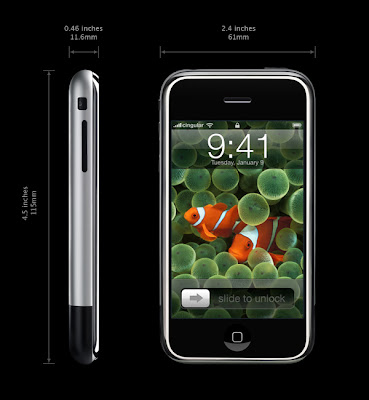
A while back I read an interesting article about the state of mobile industry as an entity trapped in the doldrums - the phones are cool but slow (e.g. Nokia's N series), phone carriers are acting out a scene from a Shylock cum Goebbels play.
The writer ended by saying that although iPhone might not solve the mobile industry's problems, let alone consumers, it might be the bright light, or a kick in the pants for everyone in the industry, propelling phone makers to go back to the drawing board.
I have seen the new Apple ads for iPhone - as usual they are cool.
The
launch date is confirmed - June 29.
I am sure people would find the iPhone cool, just like the iPod, but one hopes that someone finishes the hegemony of phone carriers. The iPhone, in its present format is not that device.
Related iPhone and Cellphone innovation coverage on MediaVidea:6 Reasons why the Googlephone is a good ideaWhat's next in mobilesApple's iPhone: & important issuesNotes on the ideal cellphoneLabels: apple, iPhone, mobile
Back to the future: when Mobile Operators turned into ISPs
I knew mobile data is big. How big it really is I did not know till today when I read in the
Guardian that
mobile content is worth more than web content.Informa calculates that
content on mobile networks brought in $31 billion against $25 billion worth of business done on the web.While
porn and gambling accounted for a big part of online revenues, the mobile content business is dominated by five content groups:
music, infotainment, images, videogames and web browsing.Reading this many of you might think:
well then, what are we doing writing rambling articles online, that anyway few people read?However
, I don’t think mobile content will always be a Paid For business. A crazy mix of technologies are on the horizon – wifi, wimax, Bluetooth, VoIP, P2P, and others – and some technologies that are yet to come that will one day turn Mobile providers from the dour gatekeepers of today to
building supers of future, just like the ISPs of tomorrow.
In 10 years, the cellphone has become a ubiquitous tool, even found in the hands of those film extras in awful commercials. In 10 years’ time, people will have found a way out of the clutches of the Mobile service providers.
Labels: mobile, research report


