Apple, Google, Facebook, Amazon, Telcos, and the Credit card company: Who will free us from the six horsemen of the consumeropocalypse?
The
first four horsemen of our ultramodern '
consumeropocalypse' are:
1. Apple - gadget culture, cult of we-are-cool-you-aren't, Foxconn sweatshops/suicides, versions after versions, must buy newest version, walled garden)
2. Google - pseudo-organizing the world's information, more Google products listed in search results than ever before, precedence to spammy aggregators like Huffington Post, copying newer online successes all the time, Google+ social networking, Android - more people use mobile phones, more people search Google
3. Facebook - where all our time goes nowadays, oversharing by people, timewasters as Facebook's main product, copying newer online successes all the time, soylent green 2.0
4. Amazon - cloud data service, digital media, book publishing, kindle, superstore...
Farhad Manjoo writes about these
big four.
Then, there are two more:
5. The
telcos, the wireless companies, the ISPs - gatekeepers, anti-net neutrality
6. The
credit-card company - damn, no one gets big by telling us not to buy, buy, buy, and we are drowning in the all the fine print
Between these extremes of consumerocracy, we are all fucked. And, the scariest part:
The best tech companies stay at their peak for a decade at most. Amazon, Apple, Facebook, and Google have the potential to be exceptions.
Whatever the future will look like (I like Clifford Stoll's idea that the future is not being about what tools we will be using, but to know the future, ask the kindergarten teacher), it increasingly looks like we will end our lives as
serfs of these big four/six.
Labels: apple, google, trends
Medium Cool 2.0: Or, how much the world (don't really) needs Apple
Labels: apple, graphic
Those were the days (The Jobs and Gates show)
Labels: apple, obituary
The world's most powerful brand is the least useful (and how useless most rankings really are)
Most rankings are only guestimates based on favorites of a very small focus group. But when one such ranking, world's most powerful brands, ranked Google as the number 1, we sort of agreed. Because no other internet service/major brand today is as useful as Google. Whether you were a poor student in Patna or a fashion designer in Paris, Google was your guide to information and actionable intelligence.
Now Apple is
at the top of the list Top 100 global brands. But what use is Apple to most of the world? It is the least useful globally.
And, what exactly does being powerful mean? Other than the fact that Apple is able to influence the influencers through various subliminal means, what other power are we talking about here?
In comparison, even evil Microsoft is better than Apple. Just ask all those users of Win XP Service Pack 2 (free, pirated editions) worldwide. What good is a piece of technology if it can't be copied? There, I said it.
So, what explains the rise of Apple? Is it only the rise of mobile devices and shiny tablets? In many ways, the state of the IT industry is similar to the early decades of automobiles, but the difference here is that everyoene is touting everyone else should buy the latest Mercedes Benz and not Model T (and drive only on roads approved by Mercedes).
Labels: apple
The #1 problem with the Apple vs. Win and all other kinds of consumer fanboys and fangirls: The rise of consumer fascism
There is indeed such as thing as a sane person. There is no such thing as a Mac person, or a PC person. Or a Facebook person or Twitter person. Doesn't it all sound fascist? I use an Apple computer. So, I must be a better person than others who don't use Apple computers.
Recently, Hunch.com, a site I don't know what it does, but it has been around for while, surveyed its users on the popular rant-generating topic of Apple vs.Windows users and somehow came to the conclusion that Apple users are more liberal than Windows users. It is 100%B.S. I guess someone inferred the results by analyzing the great people from all those "think different" ads.
Comparisons, especially concerning '
who buys what and what does that mean', are distasteful, waste sinks of time, and shallow as well.
What is wrong with cults? In brief:
1. Consumer cults such as Apple and followers of sports clubs exhibit illiberal tendencies.
Rephrasing Agent Smith:
Cults are the disease of modern consumerist life. Self-importance is only a step away from fascism.
How? You ask. In his last book,
Kingdom Come (2006), JG Ballard, wrote about consumerism being equal to fascism. This
book review is from the Observer:
Ballard's central idea is that consumerism slides into fascism when politics simply gives the punters what they want, becoming a matter of consumer-style choices...
2. Being in an Apple cult is the heights of irony.
A Hacker News commenter said some time back
about the Apple fanboys:
Mac fanboys are like the Goth kids of the adult world - they profess individual expression, but all act and dress the same.
It's amusing that a group that touts themselves as valuing individuality and creativity all use the same restrictive devices with very little choice.
Labels: apple, trends
Students to Apple-Hawking Journalism School: Don’t make us buy iPads (or any other Apple product)
It is not only art directors for movies and TV shows that fall prey to Apple's subliminal selling push. Apple targets schools with a vengeance, adding further cost to the already expensive education, education which may or may not be fruitful in the long run. Now, students of the the Missouri School of Journalism have
spoken against the school's directive to
buy an iPad before they sit in a class.
The students write,
Leave it up to the student to decide if they’d rather record an interview on a new iPod touch or a simple tape recorder. Massive, general technological requirements do little for productivity, considering they are rarely utilized, if at all.
And,
We strongly urge the J school to stop requiring new technologies for their students, especially when they haven’t even found useful ways to utilize the current ones, like the iPod touch.
And, then this,
...They aren’t even friendly recommendations — they’re endorsements.
Labels: apple, trends
Considering the effect of the internet on religion (and the effect of religion on internet)
Everybody asks, "What effect has the internet had on religion?", but nobody asks what effect has religion had on the internet.
The general explanation for
the effect of the internet on religion is something like what Professor Heidi Campbell, author of '
When Religion Meets New Media' explains,
"The distinctions and differences (between religions) are amplified online."
That about sums it up. But,
what about the effect of religion on the internet? For example, is religious conservatism linked to the Internet-Controlling measures such as Net Neutrality, Net Censorships, and such? Or, are we talking about a different kind of religion here? The religion of power?
Or, is the cult of Apple online affected by the cult of Scientology? The cult of
Scientology, as you know, is a
like a multi-level-marketing program where a member's worth is increased by the number of people he brings in to the fold. Similarly, having once purchased a needlessly expensive gadget, which puts limits to your extent of using it, the buyer is compelled to promote the cult of Apple, as there is no other way he could justify his excessive spending in today's times of economic turmoil.
Labels: apple, books, religion, trends
No one needs an ipad, but why are people buying them? Introducing the Cave man theory of gadgets
In 1 year, Apple has sold more than 15 million iPads. The iPad cannot replace your PC, nor can it be carried in your pocket. But,
why are people buying it? Wired magazine
explains this, and I call it the
Cave man theory of gadgets:
...the tablet’s main appeal lies in the approachable touchscreen interface that just about anybody at any age can pick up and figure out.
'Figure out'. This is the key. iPads are the Hermes scarves of gadgets. They have no fixed use. But they do look fancy. The fancy/rich people like them a lot. So, they must be useful. Let's try to browse the web. Let's look at some videos. Let's check out that cool new website. Wait! The Apple guys won't let you see that '
unauthorized' website.
The cave man has bumped into the outer walls of Apple's walled garden.
Labels: apple
What do you mean by 'Tech-savvy Indians? (or, why most Indians don't need Apple)
What defines a technology-savvy Indian? It is the Indian that understands the value of hard-earned money. It is the Indian that gets a multi-functional
mobile phone for Rs. 5000, a fully-functional
personal computer at home for Rs.12000 and a
Netbook for Rs. 15000.
All that costs just Rs. 32,000, the same as that of an iPad in India.
So, when the Economic Times writes that '
Tech-savvy Indians cry out for Apple's attention', does it point to the status-symbol-craving Indians, whose aspirations are being fed by the
marketese masquerading as news in the newspaper supplements and silly gadget shows on NDTV?
Labels: apple, india
Patriot App: A Case of Crowdsourcing/Social Sharing Gone too Far?

The 'George Bushy'
Patriot App. has been developed by a company staffed with former Homeland Security staffers. It is meant to get 'concerned citizens' to be the state's 'eyes and ears'.
This app was founded on the belief that citizens can provide the most sophisticated and broad network of eyes and ears necessary to prevent terrorism, crime, environmental negligence, or other malicious behavior.
Using the Patriot App. , users can 'download, report (including pictures) and submit information to relevant government agencies, employers, or publish incident data to social network tools.'
Next up: Your neighbor as the Mini-me version of Big Brother?
Labels: apple, privacy issues
Is Apple the No. 1 Danger To Internet Freedom?
Tim Wu, a Columbia law professor, who is credited for coining the term 'net neutrality,' has now written a book titled book 'The Master Switch: The Rise and Fall of Information Empires' warns us that (apart from Governments), Apple, with its iPad/App market is one of biggest dangers to the freedom of the Internet.
He explains to the New York Times,
'I know the Internet was designed to resist integration, designed to resist centralized control, and that design defeated firms like AOL and Time Warner. But firms today, like Apple, make it unclear if the Internet is something lasting or just another cycle.'
'Right now, I'd have to say Apple.'
So, how do we deal with Apple's threat of a pretty, vast, closed system?
This Slashdot comment
says it best,
The entire threat posed by Apple comes to nought if people don't buy Apple products. I'm doing my bit.
Labels: apple, trends
Finding the Bill Gates and Steve Jobs of the web 2.0 era

The PC Era is now finally over.The Bill and Steve Show that entertained us for over quarter of a century is over too. "
You and I have memories longer than the road ahead." Steve Jobs once said to Bill Gates. Bill has pushed himself out of Microsoft while
Steve is ill and can no longer look after his baby, Apple.
Where are the rivals of the web era? Or, to be more fashionable, the web 2.0 era?
- The Google guys seem to have no quarrel with the world, ostensibly sticking to their
'do no evil' marketing mantra.
- The web 2.0 pioneers, Joshua Schacter (Del.icio.us), Kevin Rose (Digg), Gabe Rivera (Techmeme), Caterina Fake (Flickr), Matt Mullenwag (Wordpress), Evan Williams (Blogger), are either too young or too mild in comparison.
The Bill Gates and Steve Jobs show also featured an all-star supporting cast of Scott McNealy (Sun), Michael Dell and Mark Andreessen of Netscape, not forgetting guest roles by John Sculley, Andrew Grove (Intel) and other PC-era heavyweights. Those were the days when technology had only started to invade our homes and our lifestyles.
In today's age of blogs, Youtube, Digg, Comments for Everythings and what not, it is a shame we don't have more of these: "You Copied Us!", "How many Windows users does it take to change a bulb?"
Then, you had nerds versus everyone else.
Now, everyone claims to be a Nerd.
Everyone claims to be an expert, famous, or both, among other things.
Everyone has a blog, Twitter account, Facebook/Myspace/Orkut Profile or a Digg account.
The Nerd has gone mainstream.
Among other web 2.0 players, there is Mark Zuckerberg (Facebook) who reportedly 'stole' his way to social networking riches. Zuckerberg tries to copy Steve Jobs. He tried to copy Jobs' seminal 1984 Introduction during the introduction of Facebook's ad system, Beacon: "
Once in a lifetime...this is the future of advertising". As the cliche goes, rest is history.
There was a third big-time entertainer during that period, Larry Ellison.
This decade, all we got was Mark Cuban and he is nowhere as newsworthy as Ellison, despite scoring a double whammy -
a blog and a team.Any random sampling of quotes from the Bill Gates and Steve Gates tells you that Bill Gates played Kevin Smith's Silent Bob (or, muttering Bob) to Steve Jobs' opinionated Jay. Both of them are Geniuses, only one of them burns brighter than the other.
Some of my favorite quotes from Bill Gates and Steve Jobs
Steve Jobs quotes"He'd be a broader guy if he had dropped acid once or gone off to an ashram when he was younger." - Steve Jobs on Bill Gates
What a computer is to me is the most remarkable tool that we have ever come up with. It’s the equivalent of a bicycle for our minds.Being the richest man in the cemetery doesn't matter to me ... Going to bed at night saying we've done something wonderful... that's what matters to me.They are shamelessly copying us. - (On Vista)
Unfortunately, people are not rebelling against Microsoft. They don’t know any better. (1994)
When I was 17, I read a quote that went something like: "If you live each day as if it was your last, someday you'll most certainly be right." It made an impression on me, and since then, for the past 33 years, I have looked in the mirror every morning and asked myself: "If today were the last day of my life, would I want to do what I am about to do today?" And whenever the answer has been "No" for too many days in a row, I know I need to change something. (2005)
Your time is limited, so don't waste it living someone else's life. Don't be trapped by dogma — which is living with the results of other people's thinking. Don't let the noise of others' opinions drown out your own inner voice. And most important, have the courage to follow your heart and intuition. They somehow already know what you truly want to become. Everything else is secondary. (2005)
The art of those commercials is not to be mean, but it is actually for the guys to like each other.- Jobs On the "P.C. and Mac" commercials, at the All Things Digital Conference 5, where he shared the stage with Bill Gates, 2007
Bill Gates QuotesMicrosoft has had clear competitors in the past. It’s a good thing we have museums to document that. (2001)
Spam will be a thing of the past in two years' time. (2004)
Microsoft looks at new ideas, they don't evaluate whether the idea will move the industry forward, they ask, 'how will it help us sell more copies of Windows?' (1998)
I wish I wasn't ... There's nothing good that comes out of that. You get more visibility as a result of it.- On Being Rich, in The Guardian, 2006
The Best quote on GatesBill Gates is a very rich man today ... and do you want to know why? The answer is one word: versions.- Dave Barry
Labels: apple, bill gates, Microsoft, steve jobs
What is design?
Clay Shirky has written an elegant article
on design, drawing upon the struggle between users who want more control and designers who often want to dictate how things should work.
Clay includes the often discussed examples of Myspace (ugly but usable), iPod (elegance, which I think is marred by Apple’s insistence of fusing the battery)
Is Design Arrogance? “I know what you want better than you. Here it is.”
Is Design Humility?Or, Is Design Problem Solving? (e.g. Google)
Apple might be making the shiniest thingy but its designers have a two decade track record of thrusting their own whims down customers’ throats. The recent brouhaha over the iPhone and locking issues is a good case in point.
Labels: apple, design, google
Chronicles of technology: 10 greatest legal battles
The Guardian lists out
10 greatest legal battles in technology and they are:
1. The Statute of Anne (gave writers a short term copyright ownership over their own works)
2. Bell v Western Union (the telephone patent dispute)
3. Marconi and the invention of radio (who invented the radio?)
4. Apple v Franklin (copying code)
5. The Betamax case (the impact of VCRs)
6. The Godfrey libel (libelous postings online)
7. The US v Microsoft (anti-trust, monopoly)
8. Dmitry Skylarov (DRM, internet laws and national boundaries)
9. MGM v Grokster (filesharing fallout)
10. Apple v Apple (Apple Computer vs Beatles’ Apple Corps – over logo)
The writer left out the “
Apple vs. Microsoft” case, (Windows being a copy of Apple), which would have Apple score a hat-trick of legal blockbusters.
We are still waiting to know
whether Facebook was a ripoff.
Labels: apple, controversey, law, legal, Microsoft
Can the iPhone rescue the mobile phone industry?
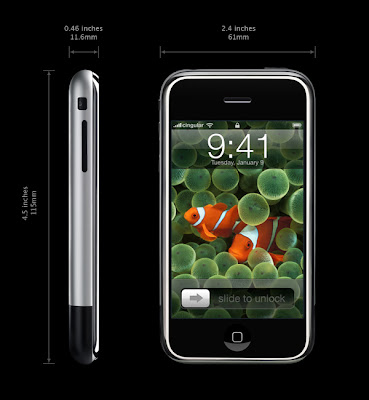
A while back I read an interesting article about the state of mobile industry as an entity trapped in the doldrums - the phones are cool but slow (e.g. Nokia's N series), phone carriers are acting out a scene from a Shylock cum Goebbels play.
The writer ended by saying that although iPhone might not solve the mobile industry's problems, let alone consumers, it might be the bright light, or a kick in the pants for everyone in the industry, propelling phone makers to go back to the drawing board.
I have seen the new Apple ads for iPhone - as usual they are cool.
The
launch date is confirmed - June 29.
I am sure people would find the iPhone cool, just like the iPod, but one hopes that someone finishes the hegemony of phone carriers. The iPhone, in its present format is not that device.
Related iPhone and Cellphone innovation coverage on MediaVidea:6 Reasons why the Googlephone is a good ideaWhat's next in mobilesApple's iPhone: & important issuesNotes on the ideal cellphoneLabels: apple, iPhone, mobile


